

We're on a mission to automate and simplify finance operations for teams working at scale.














Still wondering if
Ledge is best for close management?
Unlike other close management tools that focus on organizing and tracking close tasks or reporting progress, Ledge actually performs the work. Ledge embeds AI agents directly into workflows, so reconciliations are matched, working papers prepared, and journal entries drafted automatically before your team even starts their day.
Any type — recurring, ad hoc, cash, accruals, deferrals, FX, and adjustments. Ledge agents prepare drafts based on your ERP data and documentation for your team to review and post.
Less than one day. Import your close checklist and connect your ERP, then you’re live.
Yes — and makes it smarter. Your checklist becomes agentic: agents automatically complete or advance tasks, attach working papers, and alert you when human review is needed.
No. Ledge connects natively with ERPs, banks, payment processors, HR systems, and other major data sources without custom scripts or engineering support. We have one-click integrations so you can be connected in minutes.
Ledge is SOC 2 Type II and SOC I Type I certified. Access controls and audit trails ensure full visibility and compliance across your close process.

Working papers
AI-powered journal entries
AI flux analysis
Balance sheet reconciliation
It’s hard work to close with FloQast.
Ledge does it for you, automatically.
Why FloQast slows the close every month
1. It’s all tracking, no execution
You get a place to upload spreadsheets, checklists, and working papers. But the tasks are empty shells, so you still have to do the work.
2. It lacks true automation
It organizes your accounting workflow, but it doesn’t automate underlying tasks like reconciliations, journal entries, and working paper prep.
3. You’re swamped in manual work
Your team will still need to manually fetch and manipulate data in huge complex spreadsheets, and upload them to FloQast for storage.
4. You can’t tie the output to source data
FloQast’s AI-generated Excel files are static numbers, not formulas, so you can’t see how results were calculated, trace them back, or adjust easily.
5. Your team will be stuck in spreadsheets
FloQast does not auto-generate working papers. Teams perform calculations and tie-outs externally in Excel, then upload the finished documents.
6. It’s not built to scale
As it was built for static, end-of-period balance comparisons, it often times out and fails with high-volume datasets involving millions of transactions.

AI agents do the work
Unlike FloQast, the close isn’t just tracked or reported, it’s done for you.

Books are always updated
Daily cash application, recurring JEs, and reconciliation keep you up-to-date all month long.

Audit-ready by design
Every JE, reconciliation, and working paper is tied directly to source data.
Why finance teams
choose Ledge
Let’s look at the scoreboard

Ready to close faster with AI agents?

AI agents do the grunt work
Every record links to source data
Your finance team gets more time back
Books stay current and audit-ready
The agentic AI close management platform
that does the work, not just the tracking
Stay ahead without the manual work
- Start with live data from your ERP and banks already pre-populated instead of using blank templates.
- Spot risks and avoid bottlenecks with automatic alerts about delays in dependency tasks.
- Capture the full audit trail in one system as you go with built-in approvals, evidence, and traceability.
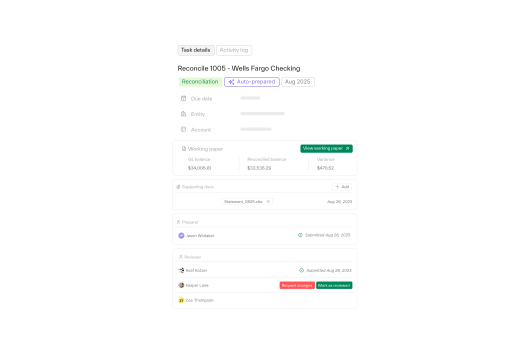
Automate source-to-source reconciliation
- Run continuous ERP-to-source reconciliation every day, and catch variances or missed transactions early.
- Auto-clear matched transactions to let your teams focus on true exceptions.
- Roll balances forward without rebuilding spreadsheets or losing track of source data as you scale.
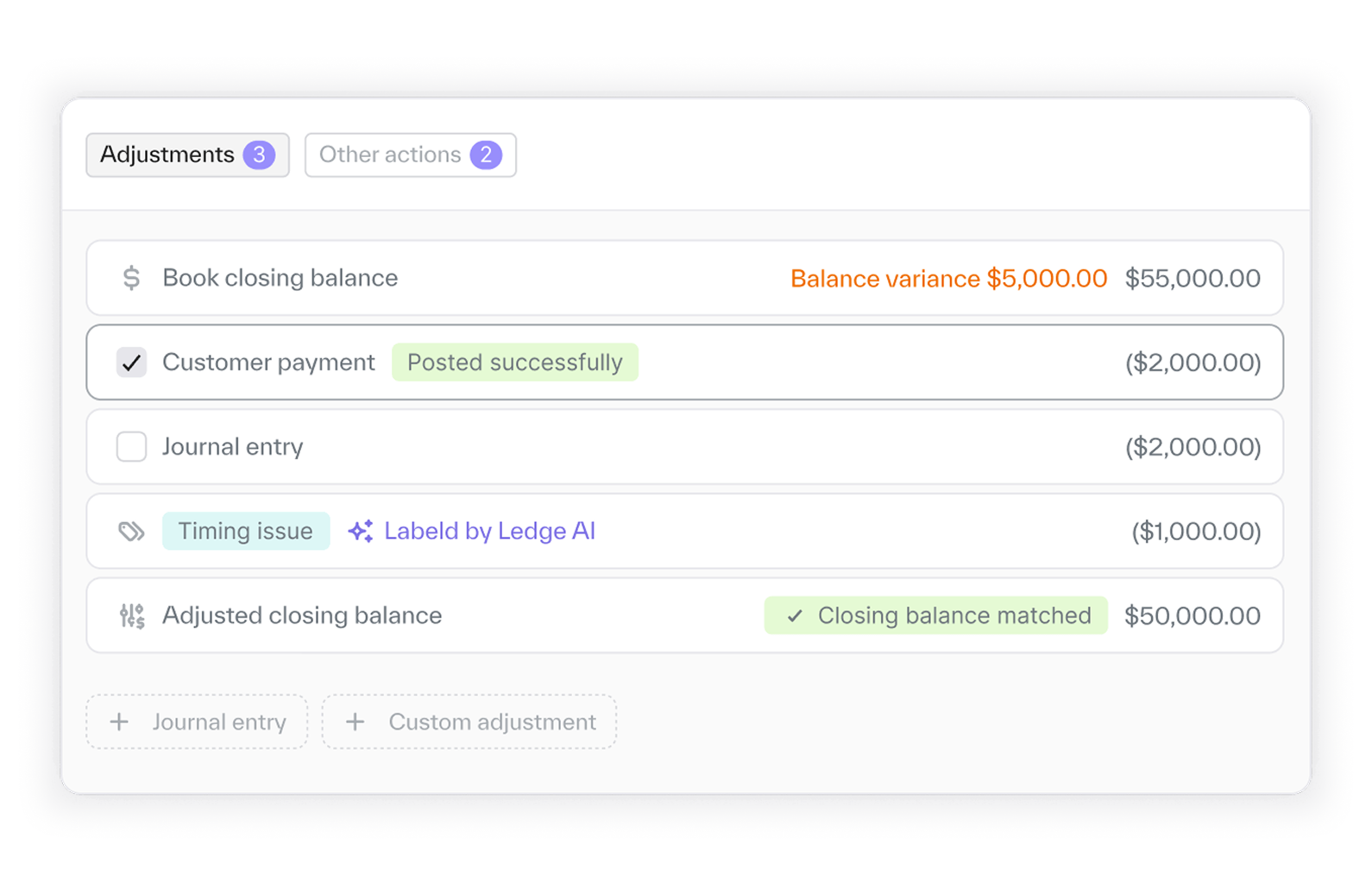
Handle working papers, automatically
- AI-generated drafts help you skip the time-consuming manual rebuild of working papers each month.
- Use roll-forward logic to keep working papers tied to the GL, giving you consistent data across periods.
- Audit-ready documentation has supporting data linked automatically, letting accountants focus on review.
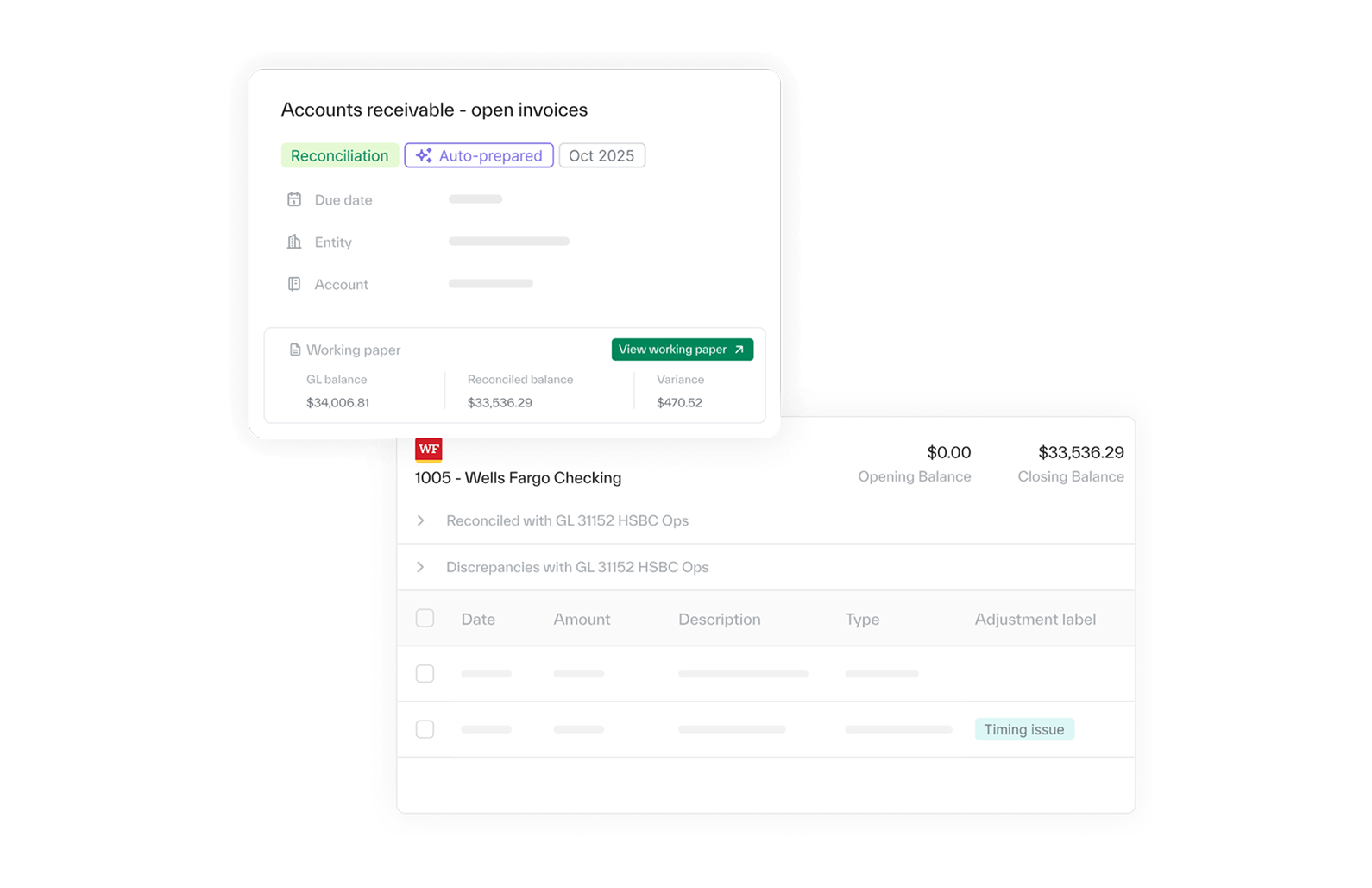
A complete JE solution inside the close
- AI agents detect and draft entries, so accountants review and approve instead of doing manual prep.
- Built-in approval workflows keep GL balances accurate and reconciled, eliminating last-minute rework.
- Every entry is linked to source data, documented automatically, and posted directly into your ERP.
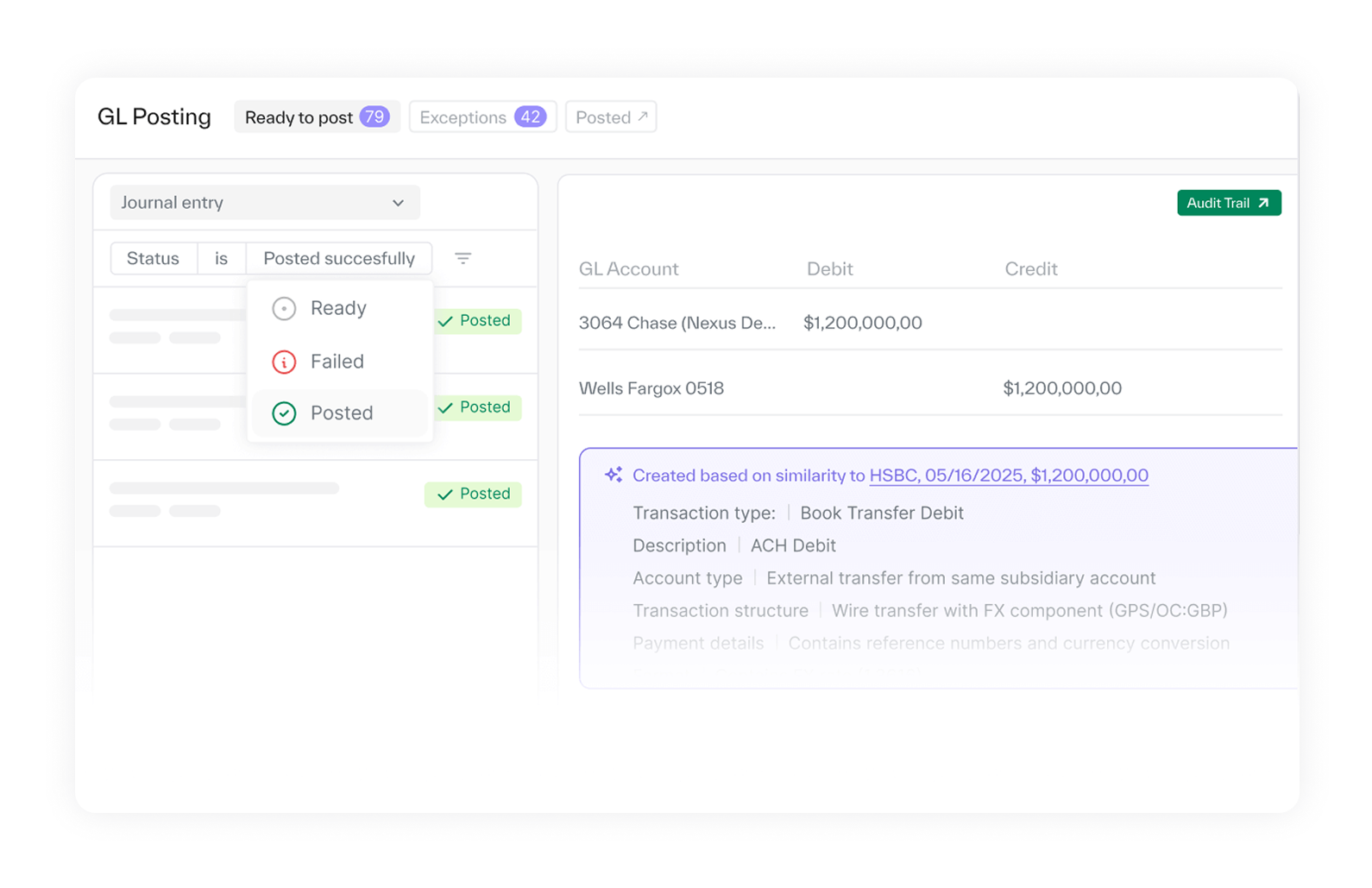
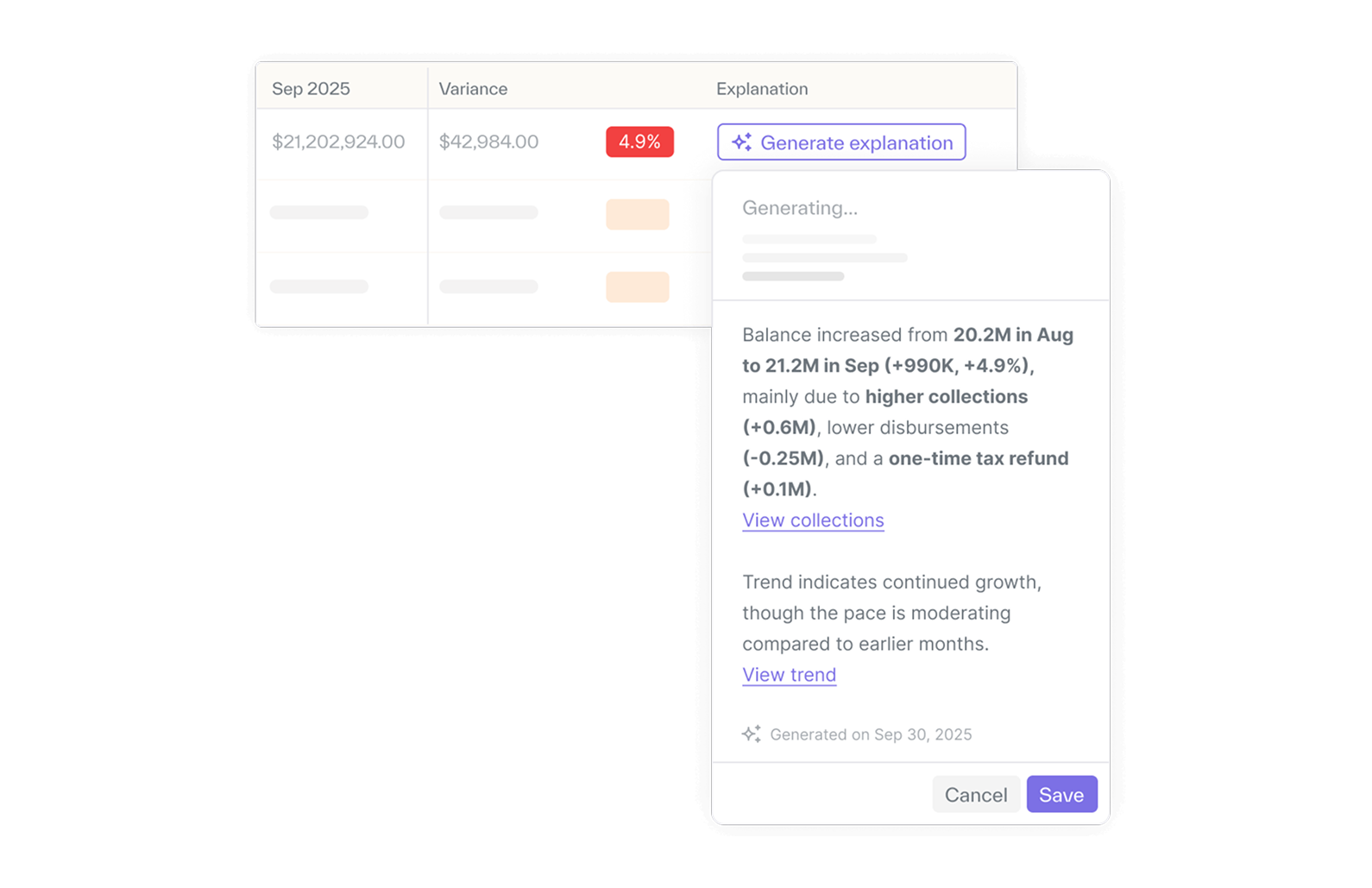
Instantly see what is causing variances
- Understand variances at a deeper level as AI analyzes drivers across accounts, departments, and entities.
- AI agents draft explanations with broad operational context, saving you hours of manual analysis.
- Give CFOs instant visibility into business drivers — cash, spend, margins — without waiting weeks.

Okay, let’s go
head to head
FloQast
Leaves the users with hard work
With architecture built for static, end-of-period balance comparisons, FloQast only takes ending numbers, not transaction-level data.
Limited connectivity beyond the GL
FloQast is effectively confined to general ledger data, with no direct integrations to banks, PSPs, billing systems. or data warehouses.
Unreliable reconciliation
FloQast’s auto-match engine delivers low accuracy, often identifying only 50–80% of matches even in simple scenarios.
You can’t control the AI agents
Each agent must be manually scripted by FloQast’s customer success team. This “black box” dependency offers users no control or transparency.
Fails at scale
The outdated system struggles with high-volume datasets, and reconciliations with millions of transactions often time out or fail.
Ledge
Modern architecture for continuous reconciliation
Built for live, transaction-level data processing and real-time reconciliation, Ledge performs well even with high volume datasets.
End manual file handling with direct connections
Integrates with banks, processors, billing systems, and warehouses for continuous, multi-source reconciliations.
Reliable, explainable auto-matching
Ledge’s matching engine uses deterministic, adaptive matching for standard and complex scenarios, minimizing manual work.
Pre-trained, self-service AI agents do the work
You can configure AI agents to apply cash daily, post recurring JEs automatically, and reconcile accounts continuously throughout the month.
Its value increases at scale
Ledge is designed to handle enterprise volumes, processing millions of daily transactions across multiple entities with no degradation.


Long, with heavy data preparation needed
Tedious ongoing maintenance and admin, with limited bulk-update tools
Built for static, end-of-period balance comparisons
Static, opaque outputs with no formulas or traceable logic
Limited beyond the GL, which creates fragmented processes
Adds tracking, without intel. Like Google Sheets with extra steps
Hallucinations and blind spots lead to 50-80% accuracy
Spreadsheet-based with manual work and uploads
Has “black box” dependency on FloQast for every change
No built-in load processing. Fails at high transaction volumes
Premium-priced with limited automation ROI
Onboarding
Implementation
Architecture
Excel output
Connectivity
Checklists
Reconciliation
Working papers
AI agents
Scalability
Value for money


Complete in hours via prebuilt agents and instant imports
Agents build workflows based on historic data. Minimal admin needed.
Built for continuous processing and real-time reconciliationx
Live, transparent sheets for accountants to trace, audit, and reuse
Integrates with banks, processors, billing systems, and warehouses
Dynamic with auto-updates as agents complete work
Deterministic, adaptive matching for standard and complex scenarios
Auto-generated to keep you audit-ready
Pre-trained, self-service, and configurable by the user
Handles millions of transactions daily with no degradation
Measurable ROI from day one by eliminating manual tasks
What getting started looks like with Ledge
Your close, live in Ledge

Import your existing close checklist
Click to connect to your ERP
Get task ownership, visibility, alerts, and orchestration
Tasks handed off
Turn checklist tasks into automated workflows
Click-to-connect banks, HRIS, billing, and hundreds more
Configure your first agents
An agent-driven close
Agents running core checklist tasks
Reconciliations, workpapers, and flux prepared end-to-end
Journal entries drafted or posted to your ERP
Day 1
Week 1
Day 30
